Lights across the Bay: SLAC and Berkeley Lab host joint users' meeting
The region’s three powerful X-ray light sources attract researchers who study atomic-scale processes to drive innovation in batteries, biomedicine and more.
Key takeaways:
- For the first time, SLAC and Lawrence Berkeley National Laboratory co-hosted a joint users’ meeting, bringing scientific communities together to foster collaboration with the nation's leading light sources.
- Workshops, panels, and presentations focused on how ultrabright X-ray light sources are accelerating discoveries in areas such as energy storage, biomedical applications, and fundamental explorations of materials found in planets and stars.
- The meeting comes at a time of transformation, with major upgrades underway at two of the light sources, and highlights how the facilities can support each other and the broader user community during these transitions.
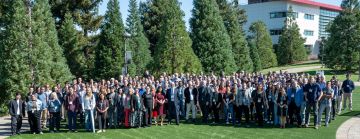
More than 700 scientists converged Sept. 24-28 at the Bay Area Light Sources Joint Users’ Meeting held at the U.S. Department of Energy’s (DOE) SLAC National Accelerator Laboratory and co-hosted by DOE’s Lawrence Berkeley National Laboratory (LBNL).
The weeklong event gave facility users and staff scientists the opportunity to learn new skills, showcase research results, and chart future explorations in today’s science landscape.
This was the first year that the two national labs jointly hosted a meeting of researchers from institutions across the country and world who conduct research at SLAC’s two light sources, the Stanford Synchrotron Radiation Lightsource (SSRL) and the Linac Coherent Light Source (LCLS), or at the Advanced Light Source(ALS) synchrotron located at Berkeley Lab across the San Francisco Bay.


Associate Laboratory Director, SSRLThe collaboration among light sources has been a very rich one, and it gets better all the time.
“It’s terrific to be part of this historic first Bay Area users’ meeting for all three light sources,” said Paul McIntyre, associate lab director for SSRL. “The collaboration among light sources has been a very rich one, and it gets better all the time.”
Each of the three light sources has strengths that make it ideal for specific kinds of scientific questions, and all three regularly undergo upgrades to enhance their capabilities. SLAC’s LCLS light source is undergoing an upgrade to deliver a 3,000-fold increase in brightness to capture images with atomic resolution.
Associate Laboratory Director, LCLSWe’ve built and are finalizing a new superconducting accelerator that I believe will be transformative for X-ray science.
“LCLS has been in continuous transformation for 10 years now,” said Kelly Gaffney, associate lab director for LCLS. “We’ve built and are finalizing a new superconducting accelerator that I believe will be transformative for X-ray science.”
With ALS scheduled for upgrades that will require a lengthy shutdown, the Berkeley Lab facility’s roughly 1,600 users will be looking to alternative light sources where they can study energy, biosciences, physics and materials.
Advanced Light Source Division Director, Lawrence Berkeley National LaboratoryThis is a great time for collaboration and sharing of expertise not only between the User Facilities and the user community, which is absolutely paramount, but also between the national labs.
“There is a tremendous community here in the Bay Area,” said Dimitri Argyriou, ALS division director at Berkeley Lab. “This is a great time for collaboration and sharing of expertise not only between the User Facilities and the user community, which is absolutely paramount, but also between the national labs.”
SSRL’s role in assisting ALS facility users was one of the reasons for deciding to hold the joint meeting, said Britt Hedman, science director for SSRL.
“We wanted to organize this meeting in such a way that ALS users could come to SLAC and see what our facilities offer,” Hedman said.
One of the top draws of the users’ meeting was a series of workshops where researchers can expand their range of scientific knowledge and technical skills. Popular topics this year included automation and robotics, accelerating quantum materials discovery, and X-ray imaging for earth and environmental samples.
Associate Director of Basic Energy Sciences, DOE Office of ScienceThere’s a lot of excitement in defining how SI is going to accelerate the capabilities and data that is coming out of our facilities. How do we use it faster? How do we use it better?
Bindu Nair, associate director of Basic Energy Sciences within the DOE Office of Science, commented that the light sources will benefit from DOE’s Genesis Mission, which aims to apply Super Intelligence (SI) to dramatically accelerate American science discovery as well as strengthen economic and national security.
“There’s a lot of excitement in defining how SI is going to accelerate the capabilities and data that is coming out of our facilities,” Nair said. “How do we use it faster? How do we use it better?”
A midweek poster session gave early and mid-career researchers the opportunity to share results from experiments conducted at the light sources. “I think it is important for collaborators to get out and communicate with each other to see what they are working on and learn from each other,” said Xinxin Cheng, a SLAC staff scientist and poster session participant.
Awards
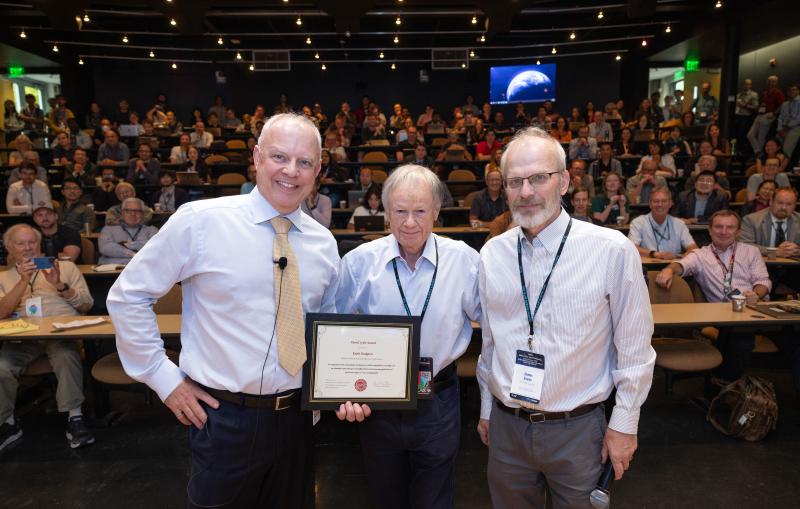
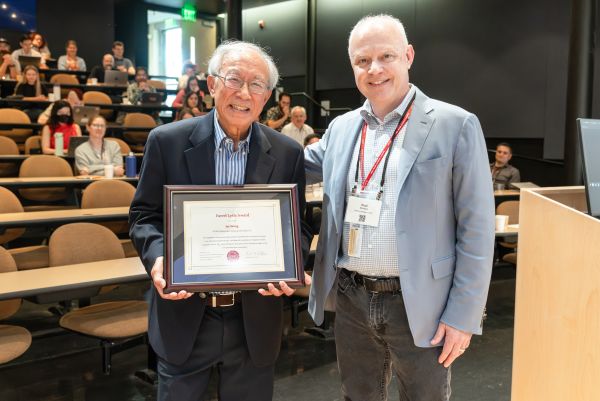
A series of awards recognized leaders in the field as well as students and early career scientists. Read about the awards.
Event organizers
The event was organized by scientific organizing committees that included chairs Silvia Pandolfi, Sorbonne University; Sarah EJ Bowman, University at Buffalo; and Shan Wu, Santa Clara University; and vice chairs Alec Follmer, University of California, Davis; Jake Pushie, University of Saskatchewan; and Coleman Kronawitter, University of California, Davis. Local organizing committees included LCLS user administrators Brittany Lamesh, Paul Jones and Brandon Tan; SSRL user administrators Laura Crowe, Lisa Dunn and Brianna Wingard; and ALS user administrators Tracy Mattox, Andy Godwin, Cindy Lee, Gianna FazioLiu and Andrea Jones.
SSRL, LCLS, and ALS are DOE Office of Science User Facilities funded by the U.S. Department of Energy.
For media inquiries, please contact media@slac.stanford.edu. For other questions or comments, contact SLAC Strategic Communications & External Affairs at communications@slac.stanford.edu.
----------------------------------------------------------------------------------------
About SLAC
SLAC National Accelerator Laboratory explores how the universe works at the biggest, smallest and fastest scales and invents powerful tools used by researchers around the globe. As world leaders in ultrafast science and bold explorers of the physics of the universe, we forge new ground in understanding our origins and building a healthier and more sustainable future. Our discovery and innovation help develop new materials and chemical processes and open unprecedented views of the cosmos and life’s most delicate machinery. Building on more than 60 years of visionary research, we help shape the future by advancing areas such as quantum technology, scientific computing and the development of next-generation accelerators.
SLAC is operated by Stanford University for the U.S. Department of Energy’s Office of Science. The Office of Science is the single largest supporter of basic research in the physical sciences in the United States and is working to address some of the most pressing challenges of our time.